-
The
Sun is one among the 200 billion stars in our Milky Way galaxy.
-
The
Sun is one among the 6000 stars, which is visible to naked eye from the
Earth.
-
The
mass of Sun is 1.989 x 1030 kg (Approximately 2
million trillion trillion kilograms).
-
The
Sun's energy output is 386 billion billion megawatt.
-
The
Earth receives 94 billion megawatt of energy from Sun. This is
equivalent to 40,000 times the power requirement of United states.
-
The
reaction taking place in Sun is nuclear fusion, same as a Hydrogen bomb.
-
Each
second 700 million tons of Hydrogen are converted to 695 million tons
of Helium and 5 million tons of energy in the form of gamma rays.
-
Each
second the Sun loses 5 million tons of material.
-
The
Sun's temperature at its core is 14 million Kelvin.
-
The
pressure at the Sun's core is 340 billion times the pressure at the
Earth's atmosphere.
-
The
density of matter at the Sun's core is about 150 times the density of
water in the Earth.
-
It
takes up to 50 million years for the energy produced at the core of the
Sun to reach its surface.
-
If
the Sun were to stop producing energy today, it would take 50 million
years for significant effects to be felt at Earth.
|
For
full information, Download Genius Maker FREE Science Software

Genius Maker Free
Edition version 3.0 File
Size 3.5 MB
|
-
If
a drop sized matter from the core of the Sun is placed on the surface
of the Earth, no living organism will survive for a distance of 150 km
from that drop.
-
The
diameter of Sun is equivalent to the diameter of 109 earths.
-
The
surface area of Sun is equivalent to that of 11990 earths.
-
The
volume of Sun is equivalent to the volume of 1.3 million earths.
-
If
the Sun were the size of a beach ball then Jupiter would be the size of
a golf ball and the Earth would be as small as a pea.
-
The
gravity at the surface of Sun is 28 times that of Earth.
-
A
man weighing 60 kg in the Earth will weigh 1680 kg in the Sun.
-
The
Sun makes up 99.86% of the mass of the solar system.
-
Unlike
the Earth, the Sun is completely gaseous, there is no solid surface on
the Sun.
-
By
weight, Sun comprises of 73% hydrogen, 25% helium, 1.5% carbon,
nitrogen, and oxygen, and 0.5% all other elements.
-
By
volume, Sun comprises of 92.1% hydrogen, 7.8% helium and 0.1% all other
elements.
-
The
Sun is at a mean distance of 149.60 million km from Earth.
-
The
light takes 8.3 minutes to travel from the Sun to Earth.
-
The
Sun's gravitational pull is so strong that, even Pluto, a planet 5.9
billion kilometer away from Sun, is kept in it's orbit.
-
Escape
velocity of any planet or star is the velocity required for any object
to escape from the gravitational pull of that planet or star. The
escape velocity of the Sun is 2.22 million km/hr.
-
The
light takes 5.5 hours to travel from the Sun to Pluto, the outer most
planet.
-
Proxima
Centauri (Alpha Centauri C) is the star nearest to Sun. It is 4.3 light
years away from Sun.
|
For
full information, Download Genius Maker FREE Science Software
Genius Maker Free
Edition version 3.0 File
Size 3.5 MB
|
-
If
our Sun were just an inch in diameter, the nearest star would be 445
miles away.
-
The
Sun rotates about it's own axis once every 25.38 days.
-
The
Sun exhibits differential rotation. The rotation period in the equator
is about 25 days, whereas in the polar regions it is as high as 36 days.
-
The
Sun orbits around the center of our Milky Way galaxy once every 240
million years.
-
The
Sun is at a distance of 30,000 light years from the center of our Milky
Way galaxy and lies on one of it's spiral arms.
-
The
Sun along with the Solar family is orbits around our Milky Way galaxy
at a velocity of 217 km/s.
-
The
Sun has circled the Milky Way galaxy for about 20 times only since it's
formation.
-
In
addition to heat and light, the Sun also emits electrons and protons,
known as the solar wind which travels at a speed of 450 km/sec.
-
Around
a trillion neutrinos from the Sun will pass through your body while you
read this sentence.
-
Solar
flares are violent explosions taking place in the Sun's atmosphere
occasionally. Solar flares can reach more than 100,000 miles away from
the sun.
-
Sunspots
appear as dark spots on the surface of the Sun. Sunspots are the
intense magnetic regions of Sun with magnetic field strengths thousands
of times stronger than the Earth's magnetic field.
-
Every
eleven years, the magnetic poles of the Sun switch. This cycle is
called "Solarmax".
-
The
luminosity of the Sun is equivalent to the luminosity of 4 trillion
trillion light bulbs of 100 watt.
-
All
the coal, oil, gas, and wood on Earth would only keep the Sun burning
for a few days.
-
An
area of the Sun's surface the size of a postage stamp shines with the
power of 1,500,000 candles.
-
The
energy being emitted from 1 square centimeter of the Sun's surface is
enough to burn 64 light bulbs of 100 watt.
-
The
amount of the Sun's energy reaching the Earth's atmosphere (known as
the Solar constant) is equivalent to 1.37 kw of electricity per square
meter.
-
The
amount of energy reaching the earth's surface from Sun is 6,000 times
the amount of energy used by all human beings worldwide.
For
full information, Download FREE Science Software by clicking below.
File
Size 3.5 MB Free
Edition version 3.0
-
The
total amount of fossil fuel used by humans since the first civilization
is equivalent to less than 30 days of energy reaching the earth's
surface from Sun.
-
If
the sun stopped shining, all living organisms in the Earth would freeze
to death, the tropics would be as cold as the poles, and the 7 seas
would turn to solid ice.
-
In
Spit Bergen, Norway at one time of the year the sun shines continuously
for three and a half months.
-
At
one time of the year, for 186 days you can not see the Sun in the North
Pole of Earth.
-
Solar
eclipses are visible in a narrow path, a maximum of 269 km wide.
-
No
Total solar eclipse can last longer than 7 minutes and 40 seconds.
-
At
any place on the Earth, a Total solar eclipse occur on an average of
once every 360 years.
-
A
maximum of 5 Solar eclipses only can occur in an year.
-
Among
the Sun and the Moon, which one is larger, when viewed from our Earth ?
Both are almost similar sized, when viewed from the Earth. Since the
orbits of both Moon and Earth are elliptical, at certain times the Moon
will be larger than the Sun and at certain other times the Sun will be
larger than the Moon.
-
The
age of Sun is 4.57 billion years.
-
The
expected life time of Sun is another 5 billion years or so.
-
After
1.1 billion years from now, the Sun will be 10 % more brighter than
today. The Earth's atmosphere will completely dry out as water vapour
is lost to space.
-
After
3.5 billion years from now, the Sun will be 40 % more brighter than
today. The oceans will evaporate into space and it means the end of all
forms of terrestrial life.
-
After
5.4 billion years from now, the Sun's core will run out of
Hydrogen.
-
After
7.7 billion years from now, the Sun will become a Red giant. It will
expand by 200 times and it will engulf the planet Mercury.
-
After
7.9 billion years from now, the Sun will become a White dwarf. The
orbital radius of other planets, including the Venus and the Earth will
be almost double that of today.
-
The
Sun will remain as a White dwarf indefinitely after 7.9 billion years.
|
|
|
|
|
|
|
|
|
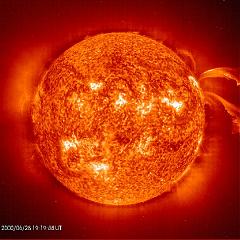
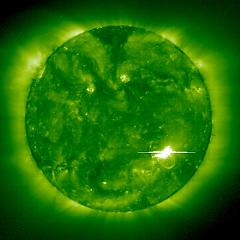
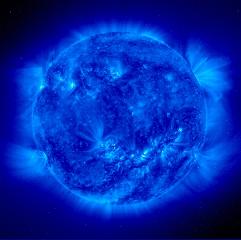
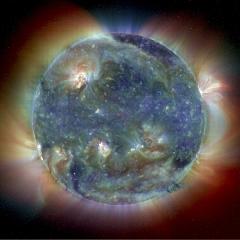
Extreme
UV images from Solar and Heliospheric Observatory (SOHO)
|
Images courtesy: SOHO (ESA
& NASA)
|
|
